The Century of Humiliation and China’s Future
Introduction
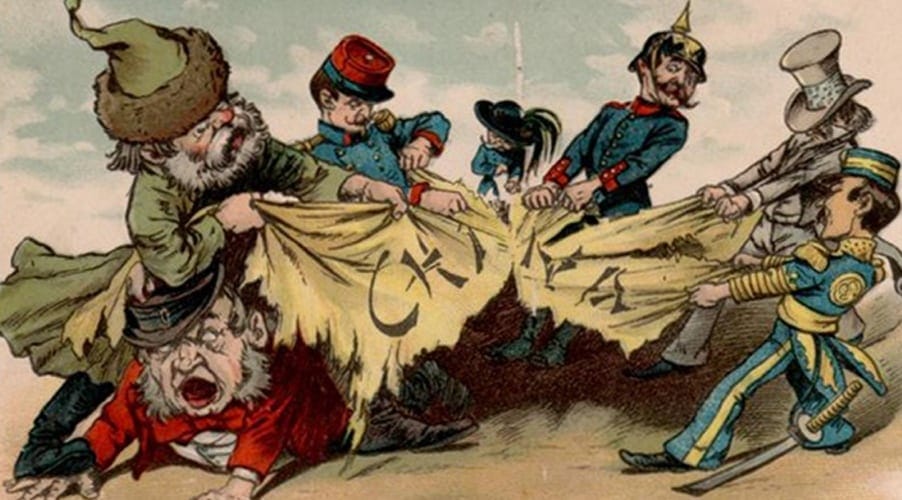
China is home to one of the oldest civilisations in the world. From 21BCE until the early 20th Century it was ruled by hereditary monarchies, through different dynasties, as Emperors from various families ruled the country. Dynastic rule ended in 1912, after a period of war fighting and interventions from imperial powers such as Britain, and Japan. The country suffered great unrest throughout this time, including many wars, some of which resulted in humiliating defeats for a very proud country. After the end of the Second World War, civil war tore the country apart, again. The Communists, led by Mao Tse-tung, were victorious and the Nationalists fled to Taiwan. China, like many countries throughout history, perceived themselves to be the centre of the world. All Under Heaven is how China saw itself, at the centre of the world, any peoples outside their borders were, considered barbarians. One can only imagine the shock and affront to their identity when these barbarians easily defeated China in several wars throughout the 19th and 20th centuries, and imposed laws and sanctions against, what they perceived to be, the best interests of Chinese citizens. China had been marginalised and reduced in status on the world stage, however, the narrative of China rising, now dominates much debate and speculation in the field of international relations. Herein I will expose how international relations theories, combined with a post-structural approach can provide an insight into the Chinese Communist Party’s use of The Century of Humiliation to drive its agenda forward.
The Century of Humiliation is taught to current Chinese students (Wang, 2014), along with the narrative of China taking back its rightful place in the world, which galvanises support amongst the population with its powerful language and symbolism. Post-positivist theories provide an understanding of why ideas and narratives, become widely held norms and have meaning and power imbued within them. A positivist realist theoretical understanding of China’s use of the country’s history may indicate that China is seeking security for itself from foreign threats or competitors, whilst maximising its power on the global stage, the Century of Humiliation and rejuvenation narrative are part of the arsenal to enable this. A liberal lens may reveal China’s actions as indicative of opening-up to the world to engage with multi-lateral organisations and groupings in order to move towards a unifying future broad, global liberal democratic rule. There are aspects of both theories that can be used to explain the current situation, but not why China is rising.
For a more complete understanding of China’s creation of power through the use of narrative and language, a post-structural analysis is effective at exposing the origins of the weaponization of history. This essay will use post-structuralism as a tool for understanding the Century of Humiliation narrative within Chinese society. First it will discuss post-structuralism itself and perceptions of China’s place in the world, from the West and from China, challenging Fukuyamas’s theory of the End of History in relation to China’s actions. It will then discuss China under Xi Jinping’s rule to illustrate how the narratives have changed through different eras in China’s modern history to support the agenda.
A post structural lens
Positivist theories of international relations (IR) are generally concerned with explaining how the world operates by examining the facts out there, through the lens of a specific theory (Kurki & Wight, 2016). Liberal and realist theories are predominantly used to describe state’s actions. Liberalism is based upon the idea that human beings, and therefore states, are perfectible and are committed to a shared goal, that off a harmonious, peaceful and progressive world. Liberal democracy, and specifically Western led liberal democracy, has been at the forefront of this, especially following the end of the second world war (Fukuyama, 1989). It accelerated again after the breakup of the Soviet Union and the fall of the Berlin Wall (Russett, 2016) as this was seen as the end of the communist project. Realist theory argues that state interests are inherently more selfish and geared towards survival and dominance in the world. That all actions, even when appearing altruistic, are ultimately for power maximisation and security (Lebow, 2016). For example, a country giving foreign aid would just be doing it to look good on the world stage and intend to gain favour from the country they have helped in the future.
Post-positive theory is concerned with a critical understanding of the world; examining why the world is as is, or is perceived, rather than just describing what is happening. Due to their inclusion of the analysis of oppression, critical theories such as Marxism and feminism are emancipatory, creating the potential for understanding and therefore giving the ability to effect political change in international relations. Critical theories enable the recognition of commonly held assumptions about our ways of thinking (Roach, 2016), giving theorists an opportunity to challenge what appears to be prima facia knowledge. Thinking such as this has helped to bring about social change as assumed knowledge about the inferiority of certain groups of people has been challenged.
Post-structuralist thought is not itself an IR theory, but rather an approach with which to understand IR and IR theory (Campbell & Bleiker, 2016). Concerned as it is with a critical understanding of theory as well as IR itself. Foucault (1982, cited in Campbell & Bleiker, 2016), writes that human beings are a historical achievement, that is, they do not just simply exist in the world they inhabit, they are the product of their upbringing, gender, the country, city, time they were born, and all their experiences. Central concepts within poststructuralism are that of identity, subjectivism and power. All three of which are created by the factors mentioned above. When one applies the same concepts to the nation state, it can be used to understand what has led a state to act as it does. As the outside world can determine how a human being behaves or thinks, so can the actions of the foreign world be crucial to understanding the domestic (ibid).
Power, according to Foucault (Campbell & Bleiker, 2016), is not just a suppressing force, used to supress and marginalise thought or action, but a productive force. The rules and limitations imposed on people or states enable us to understand what they are by the definition of what they are not (ibid). An application of this kind of shaping power can be found in the way China has conceptualised its past with regards to, not only the Century of Humiliation, but also the rule of Mao Tse-tung, and his Great Leap Forward and Cultural Revolution (Mayer, 2018). The discourse on these periods and their power on China’s history have used productive power to shape Chinese history, to mould events, in order to create the current Chinese subject. The story that has been told will, over time, stabilise and become the fixed reality (Butler, 1993, cited in Campbell & Bleiker, 2016).
China: All Under Heaven
China’s history dates back thousands of years as one of the oldest civilizations. The country as expanded and shrunk over the years as it engaged in wars with the surrounding states. However, many of the other states have been accepted into Chinese culture, conditional to adopting the Chinese way of being. So powerful was Chinese culture that even invading armies, such as the Mongols and Manchus, necessarily adopted Chinese culture to rule the country (Zhao, 2015), due to its size and large population. Around the 3rd Century BCE China was united into the first Chinese Empire and saw great prosperity, trading its valuable produce as far as Mesopotamia and Africa, through what is now known as the silk road (French, 2018). The phrase All Under Heaven, comes from the idea that China was the only true civilization, that the Emperor was divine and all peoples outside China were barbarians and should submit to Chinese rule. Outside states would be afforded protection and allowed to trade if they would kowtow to the Emperor and offer tribute.
In the 19th Century, Britain wanted to improve the trade imbalance with China, as China was exporting silk and tea to Europe and reaping the financial benefits. Britain lacked essential or desirable resources to appeal to the Chinese Empire. However, Britain was aware of increasing demand for opium and began trading huge quantities to China (French, 2018). The Emperor attempted to end opium trading through diplomatic means. When diplomatic means failed, he tried force which subsequently caused Britain to send the Royal Navy who easily defeated the Chinese military, and Britain forced the signing of, what China refers to as the, Unequal Treaties, deals which were unfairly advantageous to companies and states trading in China (ibid).
China views the First Opium War as the start of its Century of Humiliation. In 1853, due to an attempt by the Chinese to stop the opium trade, war broke out again and the Chinese suffered their second humiliating defeat to Western imperial powers. The following decades saw the further decline of the Emperor’s power, including rebellions against the Qing dynasty due to its failure to protect the country from foreign invaders and the lack of modernisation in China (Wang, 2014). From 1912 to 1949 China was ravaged by internal conflict as well as wars with Japan and involvement in both world wars. The internal rebellions were, in part, due to increased xenophobia created by the continued invasion of foreigners. While the Han majority in China had always been welcoming to other ethnicities, providing that they adopt Chinese culture, the effects of foreign influence created a suspicion of non-Han people, even the Manchu, the ethnicity of the Qing Emperor (French, 2018). After World War Two, the Chinese Communist Party (CCP) led by Mao Tse-tung won a civil against the Nationalists, many of whom escaped to the island of Taiwan. On the 1st October 1949, Mao Tse-tung declared the creation of the People’s Republic of China and stated that China had “stood up”, in reference to years of control and persecution (Wang, 2014). This was a powerful and unifying statement to make to a population who had felt under the heel of the imperial powers for decades and brought China together.
In 200 years, China has evolved from a millennia old dynasty through multiple wars, invasions and rebellions to one of the only functioning communist states in the world today. Mao Tse-tung’s rule caused the deaths of millions of Chinese people, who were killed in revolutionary purges, prison camps, or starved due to failed schemes to improve China’s economy. When Deng Xiaoping replaced Mao in 1978, he introduced a series of reforms that opened China up to the world. The West assumed this would lead to China becoming part of the world’s move towards a liberal democracy.
The End of History?
Soon after the Berlin wall fell in 1989, Fukuyama (1989) wrote an article on what he called The End of History, suggesting that given the failure of the Soviet Union and the reunification of Germany under the ideals of liberal democracy the rest of the world was now travelling the same path and liberalism and democracy had won. The US has long been seen as the lead proponent of liberal democracy and freedom in the world. Therefore, when Deng Xiaoping started to open China up in the late seventies, many in the West assumed this was the start of China’s inevitable march towards liberalism and democracy (Mayer, 2018). However, this expectation has not been met. During the communist rule of China there has been an impetus put on the memory of The Century of Humiliation, caused by the imperialist powers of Britain and Japan. China has sought to be seen in a different light to these powers and does not want to be seen to kowtow to the liberalism of much of the rest of the world, and while its actions are not always in sync with its words, it has continued this path.
Xi Jinping, China’s current leader, uses the narrative of Chinese renewal; that of China on a continuing journey to regain the trajectory it had before the Century of Humiliation (French, 2018). The economic reforms, huge infrastructure spending, investment in technology and commitments to climate change initiatives have made China a worldwide competitor; as a result, it is now the second richest country in the world. The Belt and Road initiative, launched by Xi, will spend billions of dollars worldwide, attempting to recreate the Silk Roads used to transport Chinese goods hundreds of years ago (Siddiqui, 2019). The idea of revitalising these mythical routes plays into the idea of China’s ancient hegemony and the rejuvenation narrative. The investment China is making in countries such as Africa, is sold on the world stage as preferable to the loans the West offer which invariably have conditions attached, so that Western countries can keep some control. China states there are no conditions and that their support is simply altruistic. However, there will be a huge benefit to China to have infrastructure in resource rich countries, such as countries in Africa and Central Asia (Economy, 2018).
China has also invested in Europe with billions of dollars being spent on infrastructure and state backed high tech companies (Tartar, et al. 2018). While this huge external and internal investment is being made, Xi has also been strengthening his hold on the CCP and in turn the CCP’s control of the country (Peters, 2017). Previous leaders such as Hu Jintao were recognised as generally accepting of liberal values, Xi has not been. Under his control the CCP has cracked down on universities, the media and other institutions, ensuing that any criticism of the party or Xi himself can be stamped out (French, 2018), including the restriction of the internet to stop an influx of foreign influence (Economy, 2018), therefore keeping control of the narrative and language. While Xi’s stricter regime and more powerful message on how China will interact with world has shown some evidence of slowing growth, due to tighter regulation and a clamp down on corruption (Delios,2017), China’s economy is still growing.
The Century of Humiliation
Wang (2014), cites the work of Johan Galtung who utilises classifications of events that can create a group’s, or in this case, a nation’s collective identity. The three classifications are; chosenness, myths and trauma. Chosenness is a sense of superiority and that the people have been chosen by a mystical or godlike force. Myths can act to create identity through stories of selected parts of history disseminated in the stories one tells themselves and others. Collective experiences of trauma can have a strong unifying effect. Collective experiences of trauma can have a positive influence, “bolster[ing] affiliation with the group through feelings of shared fate and destiny” and defining a part of the individual and collective identity (Hirschberger, 2018).
While events during the Century of Humiliation are historically recorded, they have been recorded in a way which benefits the CCP, creating a myth like quality to the stories told about Chinese oppression and their power to overcome. The current administration is not the first government to manipulate history; it is often said that after war, the winners who write the history, however rewriting narrative is ingrained in Chinese culture. When a new dynasty ascended to power in ancient China, the new historians would choose which parts of the previous ruler’s history to keep and which to annul or adapt (Mayer, 2018). Furthermore, the shared trauma of the Century of Humiliation is taught from a very stage at school, therefore cementing it in the minds and collective memory and identity of future generations.
Historical memory is another theory that Wang (2014) draws upon to explain the effect of creating a unified historical narrative has on the country. With the introduction of educational reforms in the early 90s, coupled with media control, the CCP was able to utilise this very real shared history as a tool to bring the country together under their control. Cementing this narrative through these means allows it to become trans-generational and self-perpetuating. A created identity can be very powerful, once it has become part of the ingrained narrative it becomes each individual’s subjective experience of being a Chinese person (Campbell & Bleiker, 2016).
How Chinese elites view the Century of Humiliation and what it means for the country going forward varies. Kaufman (2010), suggests that the international system in which China has been forced to participate, continues to disadvantage China, that China can now work within system or that China can now change the system, not only for its own benefit but for that of the worlds. The argument that the international system is damaging utilises the Century of humiliation to perpetuate a victim narrative, that despite its strength now, the West continues to subjugate China. This narrative is aided by Western commentators using language which suggests the US wants to contain China (Silove, 2016). China has many reasons to think that the international system is against its rise to be an equal power to the US. Liberal democratic countries have been the leading powers in the world for decades, and before China’s resurgence as an economic world power this seemed to be the future. The language used by the US suggesting that China needs to be a “responsible stakeholder” (Gurtov, 2008, p. 182) and “…manage the rise of China” (Tan, 2019), reveals that the US expects China to come along with the prevailing narrative and not define its own.
China is now the second richest country in the world and has joined global organisations and multi-lateral activities and treaties worldwide. While the CCP still preaches non-intervention and the sovereignty of states, it has shown that it has an interest in the stabilisation of the international order. This hints at an, at least small, acceptance of the current system. However, this ascendance has slowed since Xi Jinping took over. Xi has reinvigorated Chinese nationalism and utilised the anniversary of the Century of Humiliation’s defeats by the Japanese to advance his vision. In 2016 Xi made a speech which stated China’s continued aim to be a part of the global system, but that the spoils of success should be shared (Economy, 2018). Xi was the first Chinese leader to attend the world economic forum in Davos, where he again touted the benefits of a globalised world and China’s place in it (Anderlini et al. 2017). However, the control that the CCP has on foreign investment and trade tells a different story. The discourse used by Xi at high profile events such as Davos is broadcast throughout the world, while events from within China are much more secretive due to strict control of media. If China’s economy continues to grow, its armed forces continue to modernise, and it continues to have influence in Africa, the Middle East and Europe, then the idea of it becoming, not only the richest, but most powerful country in the world is not unrealistic. Consequently, China could position itself to alter the world system to suit it. It is doubtful that even the most optimistic proponents of a worldwide liberal democracy could see China abandoning its current system and adopting Western style democracy.
Since taking office Xi has promoted The Chinese Dream; a continuation of previous myths but also setting a timeline of China’s move away from times of humiliation, towards the ever nearer goal of returning to their rightful place in the world (Mazarr, M. et al. 2018). The continued use of versions of this narrative, utilised by most Chinese leaders after Mao, forces the idea that even if people are unhappy with the current system, it is essential in order to avoid a further period of humiliation. This discourse can be exploited to both demonstrate that China intends on changing the system in order to advance peace and harmony between states, as it is all too aware of the cost of forcing ideals on others, yet it is also utilised to justify what China claims are defensive actions locally. For example, it is currently engaged in building defences on islands in the South China Sea that are claimed by other countries and has continued stating its One China policy that argues Taiwan is still part of China (ibid).
It appears that under Xi Jinping’s rule, China’s view of the Century of Humiliation and the utilisation of it leans toward the third view of the system; that China is sufficiently powerful, or soon will be, to change the international system, and their experience of it will enable them to change it for the better, as they purport to not act in the same as the imperial powers of the past. However, this is not just through their own actions but changes to the hegemony of the US as well as the debates happening in Europe.
Xi Jinping also draws on the continuing narrative of Chinese rebirth and China becoming the helmsman of the world order, as opposed to a passenger is arguably more likely than China either staying out of the system due to the damage it has caused, or acquiescing with Western, liberal democratic capitalism. If one considers the prevailing narrative since the end of Mao’s era, it would be somewhat unforeseeable for China to adopt a more Western ideology given the success it is currently experiencing with its current system. By opening up their markets and allowing, at least some Western ideas of consumerism, China has been able to liberate millions of people from poverty and create a large middle class (China Power, 2017). The power of the CCP has been enforced and adopted by the Chinese people, not only through force, although one cannot dismiss this as a factor, but by a consistent narrative of fighting back against injustice, as Mao said, “a constant revolution”. Consequently, there is a shared story, a shared feeling “us” v “them”, East vs West. This story of being engaged with the West, yet not a part of the West enables the Chinese psyche to enjoy some of the excesses and lifestyle of Western capitalism, while remaining somewhat detached from it.
It is a powerful narrative and provides the CCP with examples of an alternative way to become a world leader without following in the US’s or the imperial power’s footsteps. The hegemony of Western liberal democracy and capitalism has given the US the power of the narrative, while not abiding by its own rules. In the last 100 years, America has had a direct or indirect effect on the rule of several sovereign states, be that through invasion, war, regime change, or other subversive methods (Chomsky, N. 2003). The usual justifications for these interventions are that of human rights, freedom for an oppressed people or to protect the security of the US. In many cases, Iraq, for example, the reason for going to war have been falsified, and other reasons, such as securing the oil in the region for US interests, have been put forward (ibid). As mentioned above China is approaching their interactions with other countries in different ways, by offering aid and assistance with infrastructure, free from conditions. The loans, however, which the CCP make available have tied countries into debt with China and, in Sri Lanka, resulted in China having a 99-year lease in a port when the government defaulted on its loan (Wang, Z. & Ye F. 2019). A situation not unlike the unequal treaties that China utilises to create its story of being a victim. Another example of China using a narrative of benevolence, while taking over parts of other countries.
The notion of China as a victim has not been central to the CCP’s narrative since they came to power, but one that emerged while the country was opening up to the world. Battcharya (2019), points out that once China started to trade and forge relationships with the Western world, the CCP realised that it needed to keep the flame of nationalism alive, while also taking part in globalisation. In the early 90s an education programme was started that focused on the humiliation suffered by imperial powers and entrenched the idea of China revitalising itself (French, 2018). By reinforcing the idea of China as a victim to the West, when the country opened up it could rely on its people still looking in, towards the CCP, fearful that exposure to outside powers could result in a regression back to a humiliating time. As China modernised, each new leader took it upon themselves to adapt the outlook of the CCP and how it would achieve its vision. The current version is Xi Jinping’s Chinese Dream, early on in his premiership he opened a museum that focused on the Century of Humiliation (ibid). As previously mentioned, the prevailing narrative with Western media, is that China is rising. Xi, since taking office has used the phrase rejuvenation, which again acts to ingrain in the psyche of the population that the CCP’s aim is to take back China’s rightful place in the world.
China faces a significant problem in becoming a global, economic, political and military power. In order for the CCP to maintain control it must provide what successive leaders have promised; jobs, housing, security and a prosperous future for all. This did not happen under Mao, but under Deng Xiaoping the country opened up to the world whilst stoking nationalism in order to give the impression that the CCP were the guardians of Chinese national identity and only they could ensure that the Century of Humiliation was consigned to the past (French, 2018). This powerful narrative in conjunction with huge economic growth over the last few decades has consolidated this position. However, it is hard for globalisation and nationalism to sit comfortably alongside each other, particularly with parts of Europe and the US growing increasingly isolated and showing signs of protectionism. A further issue is the effect on Chinese foreign policy: As a nation that has educated its young on the evils of imperialism from the likes of the West and Japan, when it engages with these countries on the global stage, the CCP needs to be seen to take a strong and principled stance. No longer able to rely on purely communist ideals or having the democratic legitimacy of having been voted in by the populace, nationalism and the defence of it has helped legitimacy (French, 2018).
China would appear to be stuck between a nationalistic domestic agenda, while situating itself as a potential usurper of US hegemony on the world stage and thus has to be at the forefront of a globalised world. Furthermore, due to China’s deep involvement with the global market and technology, resources and investment, it is in China’s interests to have a peaceful and prosperous world (Lagon & Lou, 2018). Counter to China’s need to be a part of this world order is its adherence to centuries old claims and its historic vision of its place at the centre of the world, not a partner or equal.
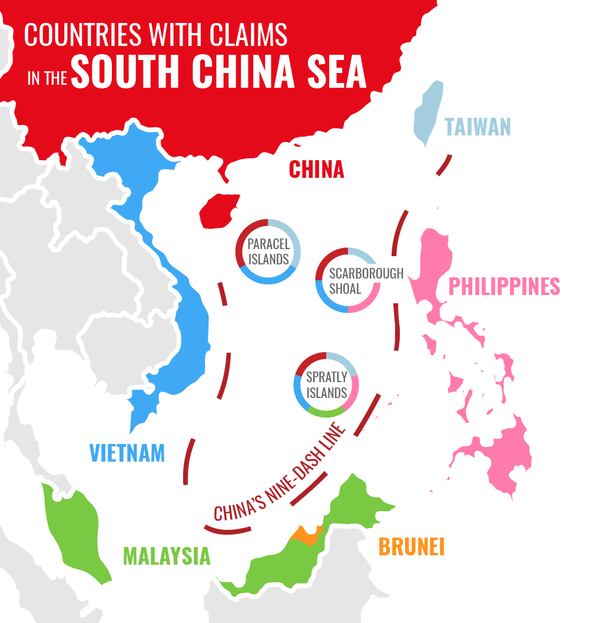
China has made territorial claims in the South China Sea that have been challenged by other nations in the region and ruled illegal by the UN (Phan & Nguyen, 2018). In most countries, that considered themselves to be a part of a world of nations, there would be some negotiation and agreements made. China has, in some circumstances allowed claimants to fish in areas it claims, but otherwise has stuck to its claim of around 80% of the South China Sea under the nine-dash line map it uses as justification for the claim (ibid). The nationalistic narrative that China has created, and which, in part, gives credence to its rule, will not allow it to look weak, especially to historical foes. Furthermore, the One China Policy that states Taiwan is part of China, causes friction around the world due to China refusing to trade with countries who recognise Taiwan as an independent country (Didier, 2016). While China’s relationship with Japan as thawed over the years which has been beneficial for both countries, China ensures that the history between the two nations is not forgotten, acting to enforce nationalism, and potentially curtailing the potential for both countries to prosper (Suzuki, 2015). One only has to look at the relationship between countries in the EU after multiple, destructive conflicts to exemplify how restoring relations can benefit all.
The Century of Humiliation was not at the forefront of Chinese communist thought when Mao Tse-tung and communist’s took control of the country in 1949. The narrative used then was one of victory, of the workers rising up and seizing control. Once China opened its doors to the world, the narrative needed to change. The language of victory could have seemed strange to the millions of people who had suffered greatly under Mao’s rule. Being able to remind the population of the way they had been treated by imperial powers turned out to be a powerful way of stoking up nationalism, avoiding capitulation of the populace to a liberal democratic ideology, while also engaging with international trade to enable economic growth and bring that population out of poverty.
Under Xi Jinping, the narrative has become that of a China that recognises the Century of Humiliation, and its usefulness, for reminding the nation of the threats of outside control and influence, and furthermore that China is now emerging from the shadows of oppression triumphantly, not unlike the Maoist narrative of 1949. Chinese elites are selecting aspects of Chinese history to create an image of the China they want to be dominant (Mayer, 2018).
China’s influence on the world over the last few decades should not be underestimated. Since the late 1970s it has evolved from a poor, largely agrarian country, to the second richest country in the world, pulled millions of people from poverty and established itself as a challenger to US hegemony. With this exposure to the world, there was an expectation that China would follow the prevailing story that leads to liberalism and democracy. As has been shown, this has not yet been realised. China has created a distinctive narrative which reflects its unique approach on the world stage, while suggesting it will avoid the mistakes made by the old empires, even as it behaves in similar ways. For the CCP to maintain its legitimacy as the leaders of a modern China, it has been necessary for the discourse on China’s history and place in the world to be adapted over time.
Leaders of the CCP have chosen what aspects of history to emphasise and alter the narrative, at times ignoring completely historical events, to shape it as necessary for its agenda. It is not argued that China did not greatly at the hands of colonial and imperial powers, however, the country also suffered greatly under the rule of Mao Tse-tung, something which is not drawn upon to define the country’s narrative; Mao is still treated as The Peoples’ Leader and arguably deified in the eyes of the nation. The interpretation and representation of purposeful parts of history is not unique to China but there is a marked difference in how the CCP presented itself from the end of Mao’s rule. Mao spoke of a great victory for China, of the people standing up and throwing off the shackles of oppression. As has been discussed, when China reformed to become part of the global system, under Deng Xiaoping, the narrative changed to ensure support from the population.
Positivist theories are inadequate to understand modern China, and the journey the country has taken to arrive at its current standing in the world. A realist perspective would attempt to explain China’s and the CCP’s actions in terms of power maximalisation and security. However, much of the actions taken over the decades run counter to a realist view, and in some cases could harm China’s interests due to exposure to the very states which caused the humiliation. A liberal view would suggest China is on its way to joining other countries in their adoption of liberal democratic values, but as discussed this is not supported by the evidence and does not appear necessary given its success as a global power. Foucault’s writing on post-structuralism, and the use of power, identity and subjectivism, give a nuanced and critical understating of the situation in the country that could be the next lead world power. Furthermore, it highlights the issues that a modern China will face as it endeavours to balance a nationalistic ethos domestically, with the inherent globalism of engaging with countries throughout the world. The story the CCP has created and continues to enforce to maintain its legitimacy will continue to be at odds with how it wants to be seen. It cannot expose weakness when dealing with competition, especially from countries who have oppressed it in the past, but this is resulting in China treating some countries in the same ways as it was treated in the past.
References:
Anderlini, J Feng,W and Mitchell,T. (2017) Xi Jinping Delivers Robust Defence of Globalisation at Davos. Financial Times Online, 17 Jan. Available at: https://www.ft.com/content/67ec2ec0-dca2-11e6-9d7c-be108f1c1dce [Accessed 09 January 2020].
Callahan, W. (2012) Sino-speak: Chinese exceptionalism and the Politics of History. The Journal of Asian Studies. 71 (1). 33-55. Cambridge. [Accessed 29 December 2019].
China Power Team (2017) How Well off is China’s Middle-Class. China Power. 29 May. Available at: https://chinapower.csis.org/china-middle-class/ [Accessed 10 January 2019].
Chomsky, N. (2003) Hegemony or Survival: America’s Quest for Global Dominance. New York: Metropolitan Books
Dunne, T., Kurki, M. & Smith, S. (2016) International Relations Theory: Discipline and Diversity. Oxford: Oxford University Press.
Didier, L. (2016) Economic diplomacy: The “one–China policy” effect on trade. China Economic Review. 48. 223-243. Science Direct. [Accessed 10 January 2020].
Economy, E. (2018) The Third Revolution. New York: Oxford University Press.
Enfu, C. & Chang’an, X. (2016) American Democracy, World Peace and the China Model – A Critical Analysis of Francis Fukuyama’s “At the ‘End of History’ Still Stands Democracy”, International Critical Thought, 6 (1), 1-12. Taylor & Francis Online. [Accessed 29 December 2019].
French, H. (2018) Everything Under the Heavens: How the Past Helps Shape China’s Push for Global Power. New York: Penguin Random House.
Fukuyama, F. (1989) The End of History. The National Interest. 3-18. Shrub Oak. [Accessed 2 January 2020].
Gurtov, M. (2008) China and the United States: Responsible Stakeholder or Emerging Threat? Asian Perspective. 32 (4). 181-183. Lynne Reinner Publishers. [Accessed 09 January 2020].
Hirschberger, G. (2018) Collective Trauma and the Social Construction of Meaning. Frontiers in Psychology. 9 (1441). 1-14. PubMed Central. [Accessed 13 January 2020].
Kaufman, A. (2010) The “Century of Humiliation,” Then and Now: Chinese Perceptions of the International Order. Pacific Focus: Inha Journal of International Studies. 25 (1). 1-33. Wiley Online Library Journals. [Accessed 29 December 2019).
Lagon, M. and Lou, T. (2018) The Dragon in Turtle Bay: The Impact of China’s Rise in the UN on the United States and Global Governance. World Affairs. 181 (3). 239-255. Sage Journals Online. [Accessed 10 January 2020].
Mayer, M. (2018) China’s historical statecraft and the return of history. International Affairs. 94 (6). 1217-1235. Oxford University Press Journals. [Accessed 02 January 2020).
Mazarr, M., Heath, T. and Cevallos, A. (2018) China and the International Order. Building a Sustainable International Order: A RAND Project to Explore U.S. Strategy in a Changing World. California: RAND Corporation.
Peters, A. (2017) The Chinese Dream: Xi Jinping thought on Socialism with Chinese characteristics for a new era. Educational Philosophy and Theory. 49 (14). 1299-1304. Taylor & Francis Online. [Accessed 28 December 2019].
Nguyen, L. and Phan, H. (2018) The South China Sea Arbitration: Bindingness, Finality, and Compliance with UNCLOS Dispute Settlement Decisions. Asian Journal of International Law. 8 (1). 36-50. Cambridge University Press Online. [Accessed 10 January 2020].
Siddiqui, K. (2019) One Belt One Road, China’s Massive Infrastructure Project to Boost Trade and Economy: An Overview. International Critical Thought. 9 (2). 214-235. Taylor & Francis Online. [Accessed 29 December 2019].
Smith, S. (2018) Community of common destiny: China’s “assertiveness” and the changing Asian order. International Journal. 73 (3). 449-463. Sage Journals Online. [Accessed 29 December 2019].
Suzuki, S. (2015) The rise of the Chinese ‘Other’ in Japan’s construction of identity: Is China a focal point of Japanese nationalism? The Pacific Review. 28 (1). 95-116. Taylor & Francis Online. [Accessed 10 January 2020].
Tan, W. (2019) Why China’s rise may call for ‘a new world order’. CNBC, 24 April. Available at: https://www.cnbc.com/2019/04/25/why-chinas-rise-may-call-for-a-new-world-order.html [Accessed 10 January 2020].
Tartar, A., Rojanasakul, M. and Diamond, J. (2018) How China is Buying its Way into Europe. Bloomberg, 23 April. Available at: https://www.bloomberg.com/graphics/2018-china-business-in-europe/ [Accessed 11 January 2020].
Wang, Z. (2013) The Chinese Dream: Concept and Context. Journal of Chinese Political Science. 19 (1). 1-13. Springer Online Journals. [Accessed 29 December 2019].
Wang, Z. (2014) Never Forget the Humiliation. New York: Columbia University Press.
Wang, Z. and Ye, Fe. (2019) China-Sri Lanka Relations in the Context of the 21st-Century Maritime Silk Road: Motives , Challenges, and Prospects. Asian Perspective. 43 (3). 481-503. John Hopkins University Press. [Accessed 10 January 2020].
Wei, G. (2011) Mao’s Legacy Revisited: It’s Lasting Impact on China and Post-Mao Era Reform. Asian Politics & Policy. 3 (1). 3-27. Wiley Online Library Journals. [Accessed 29 December 2019].
Yilmaz, S. (2018) State, Emancipation and the Rise of China. International Critical Thought. 8 (3). 366-385. Taylor & Francis Online. [Accessed 29 December 2019].
Zhao, S. (2015) Rethinking the Chinese World Order: the imperial cycle and the rise of China. Journal of Contemporary China. 24 (96). 961-982. Taylor & Francis Online. [Accessed 08 January 2020].