From Tetris to terrorist: Gamergate and the rise of the alt-right
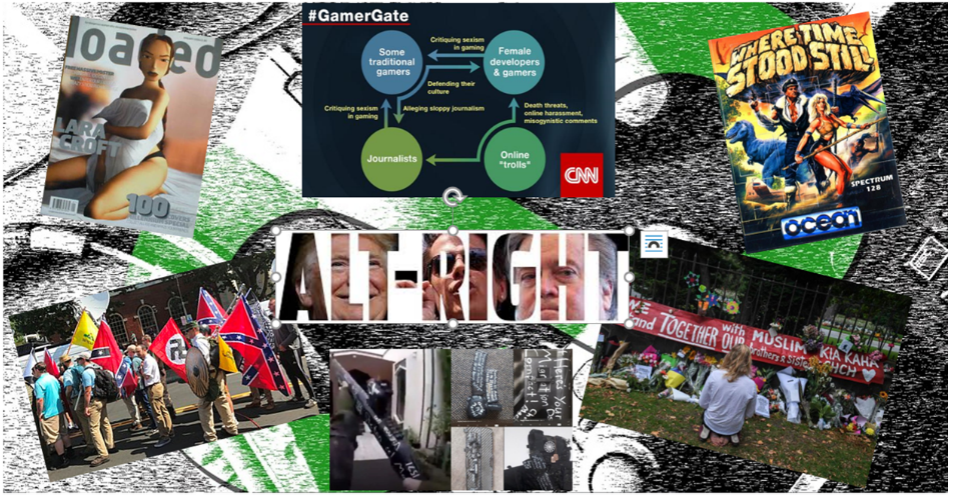
The terrorist attack in New Zealand, which claimed the lives of fifty Muslims, has once again shone a spotlight on the conduct of darker parts of the internet. The shooter used a messaging board, 8chan, to announce he was going to “…make a real-life effort post” (Time magazine), shortly before he live streamed his attack on Facebook. This is not the first time these anonymous message board have hit the headlines; Gamergate, an incident which led to the abuse of female journalists, was another event which exposed this online world. The boards’ anonymous nature, and the fact that old posts are deleted, has meant they are a breeding ground for extreme ideas now propagated by the alt-right, men’s rights groups, anti-feminists and outright Nazis. The ideas are mediated to a captive audience who absorb and disseminate them further. This article will argue that they should be subject to further investigation, especially by proponents of feminism, and equality in general.
“In a male dominated space, were women are seen as objects, it is conceivable how toxic, hegemonic ideas of masculinity can become” |
Bezio charts a small part of the history of gaming as a result of the American military industrial complex and the privileged, male dominated academic world. One required a level of education and opportunity to access the early machines and the wealth that enabled purchase of, and spare time to use, computers for games. Consequently, this group largely consisted of white, middle-class men. Games through the 80s and 90s were aggressively marketed towards this demographic. Women’s representation was hypersexualised, which made women less likely to enter the field, therefore creating less representation challenging male dominance. Bourdieu’s ideas on habitus show that these environments; created from class, culture, beliefs and language, can become normalised, they then self-perpetuate, to quote Bourdieu, “history becoming nature”. In a male dominated space, where women are seen as objects, it is conceivable how toxic, hegemonic ideas of masculinity can become. Geek masculinity, in which boys and men claim technological knowledge and talent, has created a toxic echo chamber in this online world, that is generally cut off from moderating views.
“The perpetrators of this harassment claimed that feminism was destroying gaming” |
Gamergate unveiled this toxic environment to the world. In 2014, Zoe Quinn, a feminist game developer, was accused by an ex -boyfriend of sleeping with journalists to receive positive reviews for a game she had developed. This exposed the dark underbelly of sites such as Reddit, 4chan and 8chan. Quinn and those that supported her were subject to online abuse, including doxing, where a person’s address is posted online, SWATing, where false police reports are made in the hope a house will be raided, and rape and death threats. The perpetrators of this harassment claimed that feminism was destroying gaming, that it was their last safe haven from social justice warriors and the encroaching political correctness of the modern world. Men within this environment feel that they have ownership over this space. And why wouldn’t they, there is gender bias in the industry, only twenty four percent of developers and ten percent of executives are women. However, the increase of female participation and success, is gradually eroding the conflation of technological prowess and masculinity. This feeling of persecution and an attack on inherited dominance shows parallels, and links, with the rise of another faction online, the alt-right.
The rise of the alt-right, shares some characteristics with this world. The feeling that the dominance, predominantly white males, have had, is being eroded. Bezio argues, Breitbart, a right-wing news outlet, was responsible for the mediation of Gamergate stories, demonising Quinn and her supporters. Furthermore, the language that grew out of these articles; being a real man, the derogative use of phrases such as “snowflake” and “safe spaces”, were used by Trump and his supporters during his 2016 campaign. This mediation of fringe or archaic ideas of male dominance has normalised misogynistic, anti-feminist ideas in parts of society. Anti-progressive ideas like these are often propagated on anonymous forums. They are not monitored as well as larger more commercial sites. However, during Gamergate, Reddit and 4chan did eventually ban any talk of it. Users then migrated to 8chan, where they could discuss it, without fear of being shut down. It was here that the perpetrator of the Christchurch attack posted his plan and the users of this site were the instigators of the spread of the video.
As society slowly progresses, it is important that spaces were regressive ideas are shared, are examined and not left in the shadows, self-perpetuating dangerous ideologies. Gamergate, the rise of the alt-right, Trump’s election and the attack in New Zealand have all brought these lesser known forums to the public consciousness, it is vital that they are not allowed to disappear from public discourse without challenge.
References:
Primary paper:
Bezio, K. M.S. (2018) ‘Ctrl-Alt-Del: GamerGate as a precursor to the rise of the alt-right’, Leadership, Vol. 15, No. 5, pp. 556-566, [Online]. Available at https://journals-sagepub-com.libezproxy.open.ac.uk/doi/full/10.1177/1742715018793744 (Accessed 07 April 2019).
Secondary paper:
Salter, M. (2018) ‘From geek masculinity to Gamergate: the technological rationality of online abuse’, Crime, Media, Culture: An International Journal, vol. 14, no.2, pp. 247-264 [Online]. Available at https://journals-sagepub-com.libezproxy.open.ac.uk/doi/full/10.1177/1741659017690893 (Accessed 07 April 2019).
Others:
Bennett, T. (2008), ‘Chapter 3 Habit, freedom and the governance of social conduct’, in Carter, S. du Gay, P. McFall, L. (eds.) Conduct: Sociology and Social Worlds, Manchester: Manchester University Press in association with The Open University.
Cheesman, J. (2018), Here’s How Many Tech Executives are Female (Hint: It’s Depressing) [Online], Available at https://ratedly.com/women-in-tech-report/ (Accessed 07 April 2019).
De Clercq L. (2016) ‘Why are there so few female game developers?’, Unite IT: e-Inclusion Network, 28 February [Blog]. Available at http://www.unite-it.eu/profiles/blogs/why-are-so-few-women-developing-video-games (Accessed 07 April 2019).
Perrigo, B. (2019), ‘The New Zealand Attack Exposed How White Supremacy Has Long Flourished Online’, TIME, 20 March [Online]. Available at https://time.com/5554783/white-supremacy-online-christchurch/ (Accessed 24 March 2019).
Read, M. et al, (2017), ‘Beyond alt: The extremely reactionary, burn-it-down radical, new fangled far right’, New York Magazine, 1 May [Online]. Available at http://go.galegroup.com.libezproxy.open.ac.uk/ps/i.do?id=GALE%7CA499096011&v=2.1&u=tou&it=r&p=AONE&sw=w# (Accessed 07 April 2019).